GATE · Aerospace Engineering · 2025 Set 1Practice Mode
Score:0/100(0 attempted)

General Aptitude

Q1General Aptitude · 1 mark · MCQ

Courage : Bravery :: Yearning : __________ Select the most appropriate option to complete the analogy.

Q2General Aptitude · 1 mark · MCQ

We __________ tennis in the lawn when it suddenly started to rain. Select the most appropriate option to complete the above sentence.

Q3General Aptitude · 1 mark · MCQ

A 4 × 4 digital image has pixel intensities (𝑈) as shown in the figure. The number of pixels with 𝑈≤4 is:
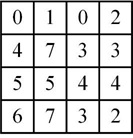
Question 3
Q4General Aptitude · 1 mark · MCQ

In the given figure, the numbers associated with the rectangle, triangle, and ellipse are 1, 2, and 3, respectively. Which one among the given options is the most appropriate combination of P, Q, and R ?
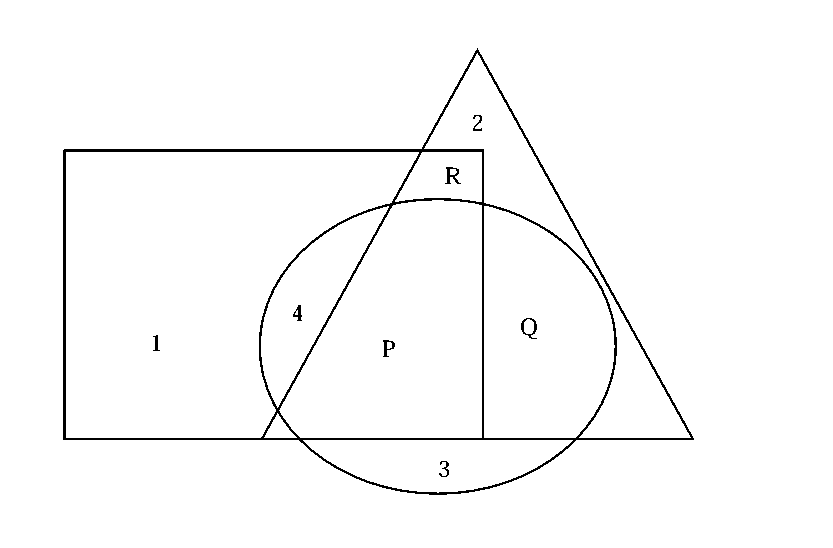
Question 4
Q5General Aptitude · 1 mark · MCQ

A rectangle has a length L and a width W, where L > W. If the width, W, is increased by 10%, which one of the following statements is correct for all values of L and W?

Q6General Aptitude · 2 marks · MCQ

Column-I has statements made by Shanthala; and, Column-II has responses given by Kanishk.
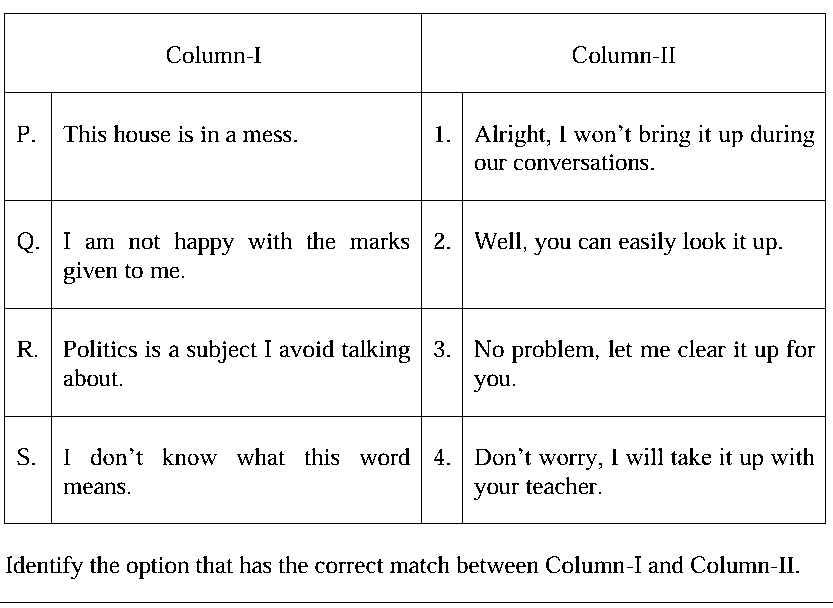
Question 6
Q7General Aptitude · 2 marks · MCQ

Weight of a person can be expressed as a function of their age. The function usually varies from person to person. Suppose this function is identical for two brothers, and it monotonically increases till the age of 50 years and then it monotonically decreases. Let a1a_1 and a2a_2 (in years) denote the ages of the brothers and a1<a2a_1 < a_2. Which one of the following statements is correct about their age on the day when they attain the same weight?

Q8General Aptitude · 2 marks · MCQ

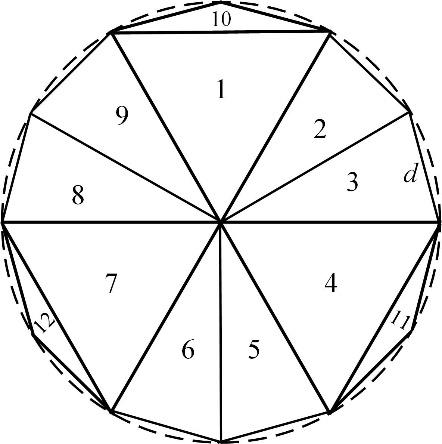
A regular dodecagon (12-sided regular polygon) is inscribed in a circle of radius r cm as shown in the figure. The side of the dodecagon is d cm. All the triangles (numbered 1 to 12) in the figure are used to form squares of side r cm and each numbered triangle is used only once to form a square.
The number of squares that can be formed and the number of triangles required to form each square, respectively, are: Note: The figure shown is representative.
Question 8
Q9General Aptitude · 2 marks · MCQ

If a real variable xx satisfies 3x2=27×9x3^{x^2} = 27 \times 9^x, then the value of 2x2(2x)2\frac{2^{x^2}}{(2^x)^2} is?

Q10General Aptitude · 2 marks · MCQ

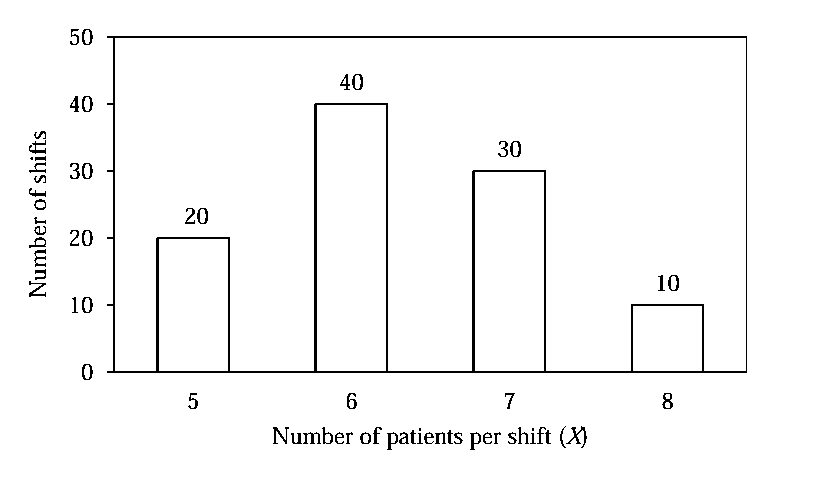
The number of patients per shift (𝑋) consulting Dr. Gita in her past 100 shifts is shown in the figure. If the amount she earns is ₹ 1000(𝑋−0.2), what is the average amount (in ₹) she has earned per shift in the past 100 shifts? Note: The figure shown is representative.
Question 10

Aerospace Engineering

Q11Aerospace Engineering · 1 mark · MCQ

For any real symmetric matrix 𝐴, the transpose of 𝐴 is ____ .

Q12Aerospace Engineering · 1 mark · MCQ

2x+3y+z=0x+y=0y+z=0\begin{aligned} &2x + 3y + z = 0 \\ &x + y = 0 \\ &y + z = 0 \end{aligned}

The given system of equations has

Q13Aerospace Engineering · 1 mark · MCQ

The eigenvalues of the matrix [1203]\begin{bmatrix}1 & 2 \\ 0 & 3\end{bmatrix} are _______

Q14Aerospace Engineering · 1 mark · MCQ

The partial differential equation 2ux2+42uxy+22uy2=0\frac{\partial^{2}u}{\partial x^{2}}+4\frac{\partial^{2}u}{\partial x\partial y}+2\frac{\partial^{2}u}{\partial y^{2}}=0 is _____.

Q15Aerospace Engineering · 1 mark · MCQ

f(x)={A+xif x<21+x2if x2If the function f(x) is continuous at x=2, the value of A is ___ ˙f(x)=\begin{cases} A+x & \text{if } x < 2 \\\\ 1+x^{2} & \text{if } x \ge 2 \end{cases} \\\\ \text{If the function } f(x) \text{ is continuous at } x = 2, \text{ the value of } A \text{ is \_\_\_\. }

Q16Aerospace Engineering · 1 mark · MCQ

If i=1,(i+1)3i1=_____.\text{If } i = \sqrt{-1}, \frac{(i+1)^{3}}{i-1} = \_\_\_\_\_.

Q17Aerospace Engineering · 1 mark · MCQ

For a two-dimensional incompressible flow over a flat plate, the laminar boundary layer thickness at a distance x from the leading edge is δ. If Rex is the Reynoldsnumber defined based on length scale x,(δx) is proportional to ____.\text{For a two-dimensional incompressible flow over a flat plate, the laminar boundary} \\\\ \text{ layer thickness at a distance } x \text{ from the leading edge is } \delta. \text{ If } Re_{x} \text{ is the Reynolds} \\\\ \text{number defined based on length scale } x, (\frac{\delta}{x}) \text{ is proportional to \_\_\_\_.}

Q18Aerospace Engineering · 1 mark · MCQ

For a NACA 4415 airfoil, the location of maximum camber, as a fraction of the chord length from the leading edge, is ______.

Q19Aerospace Engineering · 1 mark · MCQ

A positively cambered airfoil is placed in a uniform flow (velocity, U) at its zero-lift angle of attack. M is the corresponding pitching moment. Which one of the following representations accurately describes this scenario?\text{A positively cambered airfoil is placed in a uniform flow (velocity, } U_{\infty} \text{) at its } \\\\ \text{zero-lift angle of attack. M is the corresponding pitching moment. Which one of } \\\\ \text{the following representations accurately describes this scenario?}

Q20Aerospace Engineering · 1 mark · MCQ

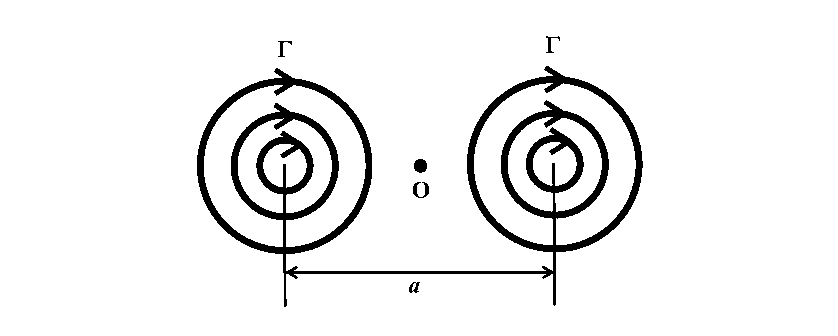
Consider a pair of point vortices with clockwise circulation Γ each. The distance between their centers is 𝑎, as shown in the figure. Assume two-dimensional, incompressible, inviscid flow. Which one of the following options is correct?
Question 20
Q21Aerospace Engineering · 1 mark · MCQ

In a fluid flow, Mach number is an estimate of _____.

Q22Aerospace Engineering · 1 mark · MCQ

A general aviation airplane is in steady and level flight. The airplane is prone to adverse yaw. Which one of the following options best describes the deflections of aileron and rudder to achieve a coordinated right turn?

Q23Aerospace Engineering · 1 mark · MCQ

For a general aviation airplane, which one of the following has a destabilizing effect on its static roll stability?

Q24Aerospace Engineering · 1 mark · MCQ

A general aviation airplane is flying at an altitude of 5000 m. The indicated airspeed is 250 km/h. Assume that there are no instrument errors and position errors. Neglecting compressibility effects, which one of the following options is FALSE?

Q25Aerospace Engineering · 1 mark · MCQ

To achieve longitudinal static stability of a general aviation airplane, which one of the following conditions should be satisfied?

Q26Aerospace Engineering · 1 mark · MCQ

For a homogeneous, isotropic material, the relation between the shear modulus (𝐺), Young’s modulus (𝐸), and Poisson’s ratio (𝜈) is ____.
Q27Aerospace Engineering · 1 mark · MCQ

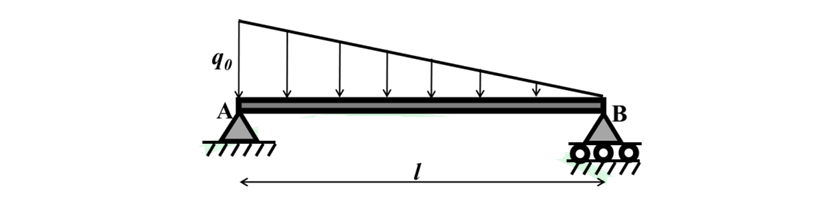
A simply supported horizontal beam is subjected to a distributed transverse load varying linearly from q0 at A to zero at B, as shown in the figure. Which one of the following options is correct?\text{A simply supported horizontal beam is subjected to a distributed transverse load } \\\\ \text{varying linearly from } q_0 \text{ at A to zero at B, as shown in the figure. } \\\\ \text{Which one of the following options is correct?}

Question 27
Q28Aerospace Engineering · 1 mark · MCQ

A stress field is given by σxx=σzz=C1y;σyy=C2y;τxy=τyz=τzx=0,where C1 and C2 are non-zero constants. If the stress field satisfies equilibrium, which one of the following options is correct?\text{A stress field is given by } \sigma_{xx} = \sigma_{zz} = C_{1}y; \sigma_{yy} = C_{2}y;\tau_{xy} = \tau_{yz} = \tau_{zx} = 0, \\\\ \text{where } C_{1} \text{ and } C_{2} \text{ are non-zero constants. If the stress field satisfies equilibrium, } \\\\ \text{which one of the following options is correct?}

Q29Aerospace Engineering · 1 mark · MCQ

A uniform symmetric cross-section cantilever beam of length 𝐿 is subjected to a transverse force 𝑃 at the free end, as shown in the figure. The Young’s modulus of the material is E and the moment of inertia is I. Ignoring the contributions due to transverse shear, the strain energy stored in the beam is _____.

Question 29
Q30Aerospace Engineering · 1 mark · MCQ

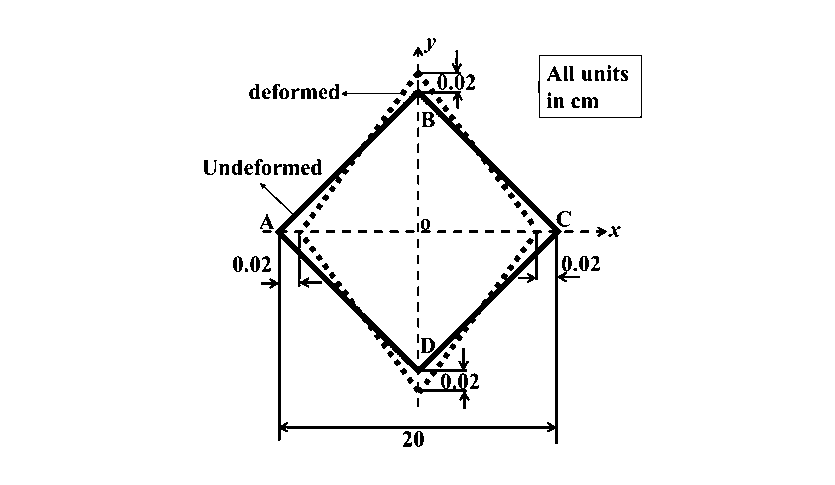
In the given figure, plate ABCD in its undeformed configuration (solid line) is a rhombus with all the internal angles being 90. The lengths of the undeformed diagonals are 20 cm. ABCD deforms as shown by the dotted lines. Upon deformation, diagonal AC reduces to 19.96 cm and BD increases to 20.04 cm. In the given x-y coordinate system, the engineering shear strain γxy is equal to\text{In the given figure, plate ABCD in its undeformed configuration (solid line) is a } \\\\ \text{rhombus with all the internal angles being } 90^{\circ}. \text{ The lengths of the undeformed } \\\\ \text{diagonals are } 20 \text{ cm. ABCD deforms as shown by the dotted lines. Upon } \\\\ \text{deformation, diagonal AC reduces to } 19.96 \text{ cm and BD increases to } 20.04 \text{ cm. } \\\\ \text{In the given } x\text{-}y \text{ coordinate system, the engineering shear strain } \gamma_{xy} \text{ is equal to}

Question 30
Q31Aerospace Engineering · 1 mark · MCQ

𝛿𝑄 and 𝛿𝑊 are the heat and work interactions of a system with its surroundings, and 𝑑𝑈 is the change in the internal energy of the system. For an adiabatic process in a closed, constant pressure combustor, which one of the following options is correct?

Q32Aerospace Engineering · 1 mark · MCQ

An ideal two-stage rocket has identical specific impulse and structural coefficient for its two stages. For an optimized rocket, the two stages have identical payload ratio as well. The payload is 2 tons and the initial mass of the rocket is 200 tons. The mass of the second stage of the rocket (including the final payload mass) is ____ tons.

Q33Aerospace Engineering · 1 mark · MCQ

A gaseous fuel mixture comprising 3 moles of methane and 2 moles of ammoniais combusted in X moles of pure oxygen in stoichiometric amount.Assuming complete combustion, with only CO2,H2O and N2 in the product gases,the value of X is3 CH4+2 NH3+X O2Products(CO2,H2O,N2)\text{A gaseous fuel mixture comprising } 3 \text{ moles of methane and } 2 \text{ moles of ammonia} \\\\ \text{is combusted in } X \text{ moles of pure oxygen in stoichiometric amount.} \\\\ \text{Assuming complete combustion, with only } CO_{2}, H_{2}O \text{ and } N_{2} \text{ in the product gases,} \\\\ \text{the value of } X \text{ is} \\\\ 3~CH_{4} + 2~NH_{3} + X~O_{2} \rightarrow \text{Products}(CO_{2}, H_{2}O, N_{2})

Q34Aerospace Engineering · 1 mark · NAT

The lift per unit span for a spinning circular cylinder in a potential flow is 6 N/m.The free-stream velocity is 30 m/s, and the density of air is 1.225 kg/m3.The circulation around the cylinder is _____ m2/s (rounded off to two decimal places).\text{The lift per unit span for a spinning circular cylinder in a potential flow is } 6 \text{ N/m.} \\\\ \text{The free-stream velocity is } 30 \text{ m/s, and the density of air is } 1.225 \text{ kg/m}^{3}. \\\\ \text{The circulation around the cylinder is \_\_\_\_\_ m}^{2}\text{/s (rounded off to two decimal places).}

Q35Aerospace Engineering · 1 mark · NAT

In a centrifugal compressor, the eye tip diameter is 10 cm. For a shaft rotational speed of 490 rotations per second, the tangential speed at the inducer tip is ___ m/s (rounded off to one decimal place).

Aerospace Engineering (AE) Page 24 of 34 Organizing Institute: IIT Roorkee

Q36Aerospace Engineering · 2 marks · MCQ

A lifting surface has a spanwise circulation distribution of Γ(θ)=Asin3θ (where A0)over its span b2yb2 and y=b2cosθ is the spanwise coordinate.Furthermore, the downwash varies along the span as w(θ)=V(3Asin3θsinθ), where V is the freestream velocity. Which one of the following options represents the total lift (L) and induced drag (Di)?\text{A lifting surface has a spanwise circulation distribution of } \Gamma(\theta)=A \sin 3\theta \text{ (where } A \ne 0) \\\\ \text{over its span } -\frac{b}{2} \le y \le \frac{b}{2} \text{ and } y = -\frac{b}{2} \cos \theta \text{ is the spanwise coordinate.} \\\\ \text{Furthermore, the downwash varies along the span as } w(\theta)=V_{\infty} \left( \frac{3A \sin 3\theta}{\sin \theta} \right), \text{ where } \\\\ V_{\infty} \text{ is the freestream velocity. Which one of the following options represents the } \\\\ \text{total lift (L) and induced drag } (D_{i})?

Q37Aerospace Engineering · 2 marks · MCQ

A 1 m long rod is to be designed to support an axial tensile load P (P >> weight of the rod). The material for the rod is to be chosen from one of the four provided in the table. Using strength-based failure criterion for design, which material results in the lowest weight of the rod?PropertiesMaterial αMaterial βMaterial γMaterial δDensity (kg/m3)2700450078009000Young’s modulus (GPa)70115200130Yield Strength (MPa)270900520540\text{A 1 m long rod is to be designed to support an axial tensile load P (P >> weight of } \\\\ \text{the rod). The material for the rod is to be chosen from one of the four provided in } \\\\ \text{the table. Using strength-based failure criterion for design, which material results } \\\\ \text{in the lowest weight of the rod?} \\\\ \begin{array}{|l|c|c|c|c|} \hline \text{Properties} & \text{Material } \alpha & \text{Material } \beta & \text{Material } \gamma & \text{Material } \delta \\ \hline \text{Density (kg/m}^3\text{)} & 2700 & 4500 & 7800 & 9000 \\ \hline \text{Young's modulus (GPa)} & 70 & 115 & 200 & 130 \\ \hline \text{Yield Strength (MPa)} & 270 & 900 & 520 & 540 \\ \hline \end{array}

Q38Aerospace Engineering · 2 marks · MSQ

A general aviation airplane is initially in steady and level flight. The stability coefficient Cmq (Cm is the airplane pitching moment coefficient and q is the pitch rate) is negative. The airplane is perturbed with a small nose-up constant pitch rate. Assume that the horizontal tail does not stall during the perturbation, and unsteady effects are neglected. When compared to steady and level flight condition, which of the following statements is/are true during the perturbed motion?\text{A general aviation airplane is initially in steady and level flight. The stability } \\\\ \text{coefficient } \frac{\partial C_{m}}{\partial q} \text{ (} C_{m} \text{ is the airplane pitching moment coefficient and q is the pitch } \\\\ \text{rate) is negative. The airplane is perturbed with a small nose-up constant pitch } \\\\ \text{rate. Assume that the horizontal tail does not stall during the perturbation, and } \\\\ \text{unsteady effects are neglected. When compared to steady and level flight } \\\\ \text{condition, which of the following statements is/are true during the perturbed } \\\\ \text{motion?}

Q39Aerospace Engineering · 2 marks · MSQ

A general aviation airplane is gliding with a speed Vg at minimum glide angle.Which of the following statements is/are true?\text{A general aviation airplane is gliding with a speed } V_{g} \text{ at minimum glide angle.} \\\\ \text{Which of the following statements is/are true?}

Q40Aerospace Engineering · 2 marks · NAT

The maximum value of the function 𝑓(𝑥) = (𝑥−1)(𝑥−2)(𝑥−3) in the domain [0, 3] occurs at 𝑥= ______(rounded off to two decimal places).
Q41Aerospace Engineering · 2 marks · NAT

limx01cos(2x)x2=_____ (answer in integer).\lim_{x\rightarrow0}\frac{1-\cos(2x)}{x^{2}}=\_\_\_\_\_ \text{ (answer in integer).}

Q42Aerospace Engineering · 2 marks · NAT

The equation of a closed curve in two-dimensional polar coordinates is given by r=2π(1sinθ). The area enclosed by the curve is _____ (answer in integer).\text{The equation of a closed curve in two-dimensional polar coordinates is given by } \\\\ r=\frac{2}{\sqrt{\pi}}(1-\sin\theta). \text{ The area enclosed by the curve is \_\_\_\_\_ (answer in integer).}

Q43Aerospace Engineering · 2 marks · NAT

Consider the ordinary differential equation: 12dydx+yx=1. If y=2/3 at x=1,  then the value of y at x=3 is _____ (rounded off to the nearest integer).\text{Consider the ordinary differential equation: } \frac{1}{2}\frac{dy}{dx}+\frac{y}{x}=1. \text{ If } y=2/3 \text{ at } x=1, \\\\\ \text{ then the value of y at } x=3 \text{ is \_\_\_\_\_ (rounded off to the nearest integer).}

Q44Aerospace Engineering · 2 marks · NAT

An approximate solution of the equation x317=0 is to be obtained using the Newton-Raphson method. If the initial guess is xo=2, the value at the end of the first iteration is x1=_____ (rounded off to two decimal places).\text{An approximate solution of the equation } x^{3}-17=0 \text{ is to be obtained using the } \\\\ \text{Newton-Raphson method. If the initial guess is } x_{o}=2, \text{ the value at the end of the}\\\\ \text{ first iteration is } x_{1}=\_\_\_\_\_ \text{ (rounded off to two decimal places).}

Q45Aerospace Engineering · 2 marks · NAT

i^ and j^ denote unit vectors in the x and y directions, respectively. The outwardflux of the two-dimensional vector field v=xi^+yj^ over the unit circle centeredat the origin is _____ (rounded off to two decimal places).\hat{i} \text{ and } \hat{j} \text{ denote unit vectors in the x and y directions, respectively. The outward} \\\\ \text{flux of the two-dimensional vector field } \vec{v}=x\hat{i}+y\hat{j} \text{ over the unit circle centered}\\\\ \text{at the origin is \_\_\_\_\_ (rounded off to two decimal places).}

Q46Aerospace Engineering · 2 marks · NAT

An aircraft is flying at an altitude of 4500 m above sea level, where the ambientpressure, temperature and density are 57 kPa, 259 K and 0.777 kg/m3,respectively. The speed of the aircraft (𝑉) is 230 m/s. Gas constant R= 287 J/kg/K, and specific heat ratio 𝛾 = 1.4. If the stagnation pressure is po, and static pressureis p, the value of [pop12ρV2] is _____ (rounded off to two decimal places).\text{An aircraft is flying at an altitude of 4500 m above sea level, where the ambient}\\\\ \text{pressure, temperature and density are 57 kPa, 259 K and 0.777 kg/m}^3, \\\\ \text{respectively. The speed of the aircraft (𝑉) is 230 m/s. Gas constant R= 287 J/kg/K, } \\\\ \text{and specific heat ratio 𝛾 = 1.4. If the stagnation pressure is } p_{o}, \text{ and static pressure} \\\\ \text{is p, the value of } [\frac{p_{o}-p}{\frac{1}{2}\rho V^{2}}] \text{ is \_\_\_\_\_ (rounded off to two decimal places).}

Q47Aerospace Engineering · 2 marks · NAT

A rectangular wing of 1.2 m chord length and aspect ratio 5 is tested in a wind tunnel at an air speed of 60 m/s. The density and the dynamic viscosity of air are 1.3 kg/m3 and 1.8×10⁵ kg/m-s, respectively. A second rectangular wing of the same span, but with an aspect ratio of 6, is to be tested in the same tunnel at the same Reynolds number. The air speed at which the second test should be performed is _____ m/s (answer in integer).\text{A rectangular wing of 1.2 m chord length and aspect ratio 5 is tested in a wind } \\\\ \text{tunnel at an air speed of 60 m/s. The density and the dynamic viscosity of air are } \\\\ 1.3 \text{ kg/m}^3 \text{ and } 1.8\times10^{-5} \text{ kg/m-s, respectively. A second rectangular wing of the } \\\\ \text{same span, but with an aspect ratio of 6, is to be tested in the same tunnel at the } \\\\ \text{same Reynolds number. The air speed at which the second test should be } \\\\ \text{performed is \_\_\_\_\_ m/s (answer in integer).}

Q48Aerospace Engineering · 2 marks · NAT

In a low-speed airplane, a venturimeter with 1.3:1 area ratio is used for airspeed measurement. The airplane’s maximum speed at sea level is 90 m/s. If the density of air at sea level is 1.225 kg/m3 the maximum pressure difference between the inlet and the throat of the venturimeter is _____ kPa (rounded off to two decimal places).\text{In a low-speed airplane, a venturimeter with 1.3:1 area ratio is used for airspeed } \\\\ \text{measurement. The airplane's maximum speed at sea level is 90 m/s. If the density } \\\\ \text{of air at sea level is 1.225 kg/m}^3 \text{ the maximum pressure difference between the } \\\\ \text{inlet and the throat of the venturimeter is \_\_\_\_\_ kPa (rounded off to two decimal places).}

Q49Aerospace Engineering · 2 marks · NAT

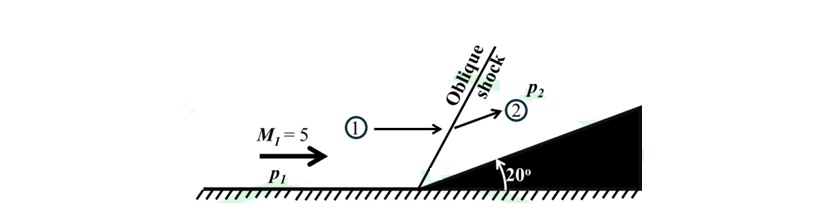
A supersonic stream of an ideal gas at Mach number M1=5 is turned by a ramp, as shown in the figure. The ramp angle is 20. The pressure ratio is p2p1=7.125and the specific heat ratio is γ=1.4. The pressure coefficient on the ramp surface is _____ (rounded off to two decimal places).\text{A supersonic stream of an ideal gas at Mach number } M_{1}=5 \text{ is turned by a ramp, } \\\\ \text{as shown in the figure. The ramp angle is } 20^{\circ}. \text{ The pressure ratio is } \frac{p_{2}}{p_{1}}=7.125 \\\\ \text{and the specific heat ratio is } \gamma=1.4. \text{ The pressure coefficient on the ramp surface } \\\\ \text{is \_\_\_\_\_ (rounded off to two decimal places).}

Question 49
Q50Aerospace Engineering · 2 marks · NAT

A perfect gas flows through a frictionless constant-area duct with heat addition. The inlet conditions are as follows: pressure 100 kPa, density 1 kg/m3, and velocity 100 m/s. At a particular downstream location, the gas velocity is 200 m/s. The static pressure at the downstream location is _____ kPa (answer in integer).\text{A perfect gas flows through a frictionless constant-area duct with heat addition. } \\\\ \text{The inlet conditions are as follows: pressure 100 kPa, density 1 kg/m}^3, \text{ and } \\\\ \text{velocity 100 m/s. At a particular downstream location, the gas velocity is 200 m/s. } \\\\ \text{The static pressure at the downstream location is \_\_\_\_\_ kPa (answer in integer).}

Q51Aerospace Engineering · 2 marks · NAT

The mass flow rate in a supersonic wind tunnel is 2 kg/s when the stagnation pressure and stagnation temperature are 1 MPa and 800 K, respectively. If the stagnation pressure and stagnation temperature are changed to 3 MPa and 200 K, the mass flow rate in the tunnel changes to _____ kg/s (answer in integer).\text{The mass flow rate in a supersonic wind tunnel is 2 kg/s when the stagnation } \\\\ \text{pressure and stagnation temperature are 1 MPa and 800 K, respectively. If the } \\\\ \text{stagnation pressure and stagnation temperature are changed to 3 MPa and 200 K, } \\\\ \text{the mass flow rate in the tunnel changes to \_\_\_\_\_ kg/s (answer in integer).}

Q52Aerospace Engineering · 2 marks · NAT

A jet-powered airplane is steadily climbing at a rate of 10 m/s. The air density is 0.8 kg/m3 and the thrust force is aligned with the flight path. Using the information provided in the table below, the airplane’s thrust to weight ratio is _____ (rounded off to one decimal place).Airplane speed80 m/sLift coefficient, CL0.8Aspect ratio6Oswald efficiency factor0.8Zero-lift drag coefficient0.02\text{A jet-powered airplane is steadily climbing at a rate of 10 m/s. The air density is } \\\\ 0.8 \text{ kg/m}^3 \text{ and the thrust force is aligned with the flight path. Using the } \\\\ \text{information provided in the table below, the airplane's thrust to weight ratio is } \\\\ \text{\_\_\_\_\_ (rounded off to one decimal place).} \\\\ \\\\ \begin{array}{|l|c|} \hline \text{Airplane speed} & 80 \text{ m/s} \\ \hline \text{Lift coefficient, } C_{L} & 0.8 \\ \hline \text{Aspect ratio} & 6 \\ \hline \text{Oswald efficiency factor} & 0.8 \\ \hline \text{Zero-lift drag coefficient} & 0.02 \\ \hline \end{array}

Q53Aerospace Engineering · 2 marks · NAT

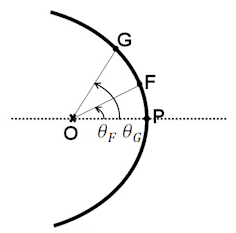
F and G denote two points on a spacecraft’s orbit around a planet, as indicated in the figure. O is the center of the planet, P is the periapsis, and the angles are as indicated in the figure. If OF=8000 km, OG=10000 km, θF=0 deg, and θG=60 deg, the eccentricity of the spacecraft’s orbit is _____ (rounded off to two decimal places).\text{F and G denote two points on a spacecraft's orbit around a planet, as indicated in } \\\\ \text{the figure. O is the center of the planet, P is the periapsis, and the angles are as } \\\\ \text{indicated in the figure. If } OF=8000 \text{ km, } OG=10000 \text{ km, } \theta_{F}=0 \text{ deg, and } \\\\ \theta_{G}=60 \text{ deg, the eccentricity of the spacecraft's orbit is \_\_\_\_\_ } \\\\ \text{(rounded off to two decimal places).}

Question 53
Q54Aerospace Engineering · 2 marks · NAT

While taking off, the net external force acting on an airplane during the ground roll segment can be assumed to be constant. The airplane starts from rest. SLO and VLO are the ground roll distance and the lift-off speed, respectively. αVLO (α>0)denotes the airplane speed at 0.5 SLO. Neglecting changes in the airplane mass during the ground roll segment, the value of α is _____ (rounded off to two decimal places).\text{While taking off, the net external force acting on an airplane during the ground } \\\\ \text{roll segment can be assumed to be constant. The airplane starts from rest. } S_{LO} \text{ and } \\\\ V_{LO} \text{ are the ground roll distance and the lift-off speed, respectively. } \alpha V_{LO} \text{ (} \alpha > 0 \text{)} \\\\ \text{denotes the airplane speed at 0.5 } S_{LO}. \text{ Neglecting changes in the airplane mass } \\\\ \text{during the ground roll segment, the value of } \alpha \text{ is \_\_\_\_\_ (rounded off to two decimal places).}

Q55Aerospace Engineering · 2 marks · NAT

A 1 m long rod of 1 cm × 1 cm cross section is subjected to an axial tensile force of 35 kN. The Young’s modulus of the material is 70 GPa. The cross-section of the deformed rod is 0.998 cm × 0.998 cm. The Poisson’s ratio of the material is _____ (rounded off to one decimal place).\text{A 1 m long rod of 1 cm } \times \text{ 1 cm cross section is subjected to an axial tensile force } \\\\ \text{of 35 kN. The Young's modulus of the material is 70 GPa. The cross-section of } \\\\ \text{the deformed rod is 0.998 cm } \times \text{ 0.998 cm. The Poisson's ratio of the material is } \\\\ \text{\_\_\_\_\_ (rounded off to one decimal place).}

Q56Aerospace Engineering · 2 marks · NAT

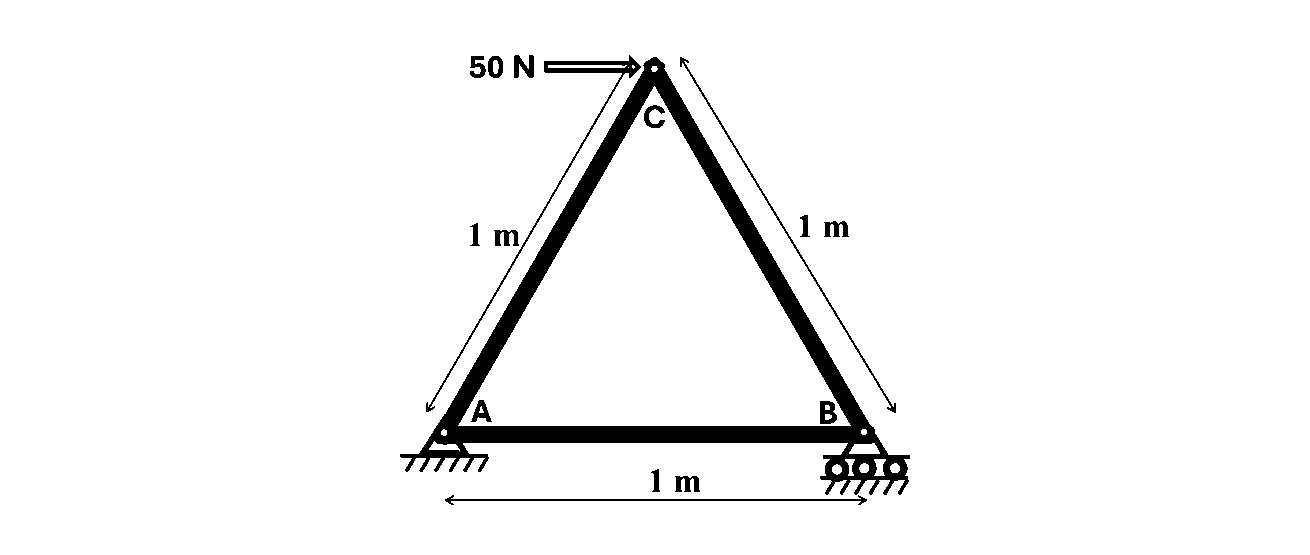
For a three-bar truss loaded as shown in the figure, the magnitude of the force in the horizontal member AB is _____ N (answer in integer).\text{For a three-bar truss loaded as shown in the figure, the magnitude of the force in } \\\\ \text{the horizontal member AB is \_\_\_\_\_ N (answer in integer).}

Question 56
Q57Aerospace Engineering · 2 marks · NAT

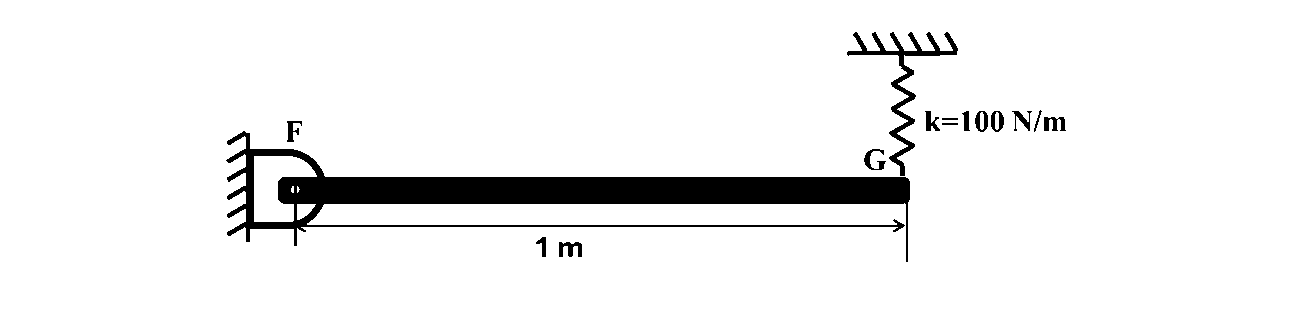
A uniform rigid bar of mass 3 kg is hinged at point F and supported by a spring of stiffness k=100 N/m as shown in the figure. The natural frequency of free vibration of the system is _____ rad/s (answer in integer).\text{A uniform rigid bar of mass 3 kg is hinged at point F and supported by a spring of } \\\\ \text{stiffness } k=100 \text{ N/m as shown in the figure. The natural frequency of free } \\\\ \text{vibration of the system is \_\_\_\_\_ rad/s (answer in integer).}

Question 57
Q58Aerospace Engineering · 2 marks · NAT

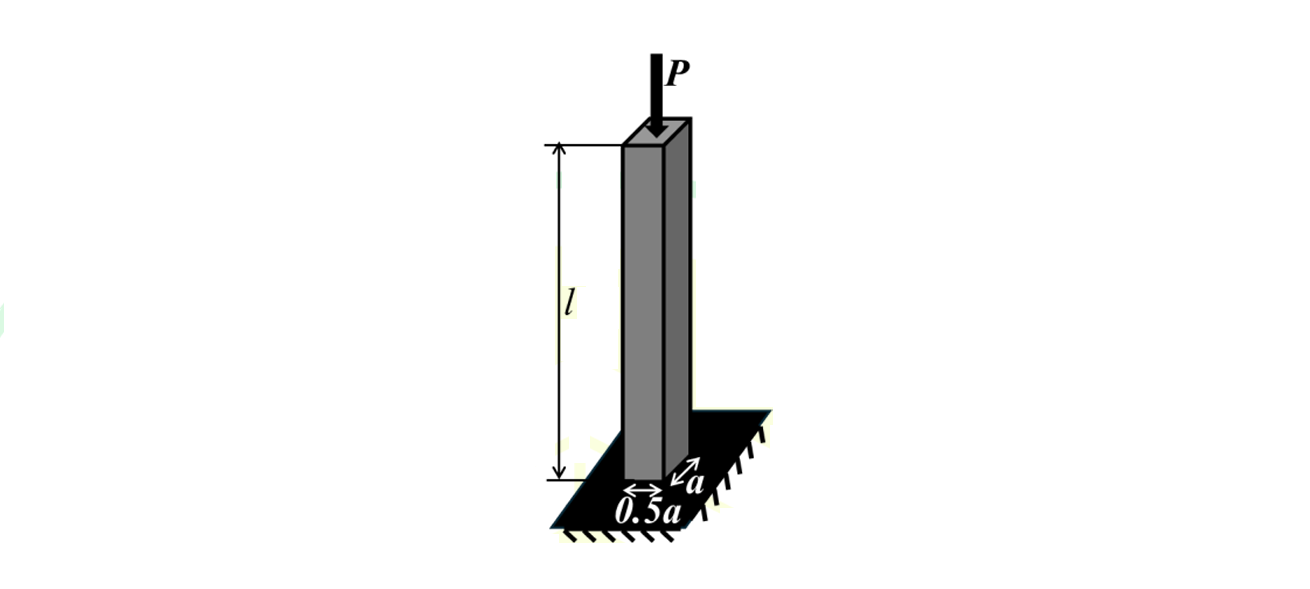
A prismatic vertical column of cross-section a×0.5a and length l is rigidly fixed at the bottom and free at the top. A compressive force P is applied along the centroidal axis at the top surface. The Young’s modulus of the material is 200 GPa and the uniaxial yield stress is 400 MPa. If the critical value of P for yielding and buckling of the column are equal, the value of (l/a) is _____ (rounded off to one decimal place).\text{A prismatic vertical column of cross-section } a \times 0.5a \text{ and length } l \text{ is rigidly fixed } \\\\ \text{at the bottom and free at the top. A compressive force P is applied along the } \\\\ \text{centroidal axis at the top surface. The Young's modulus of the material is 200 GPa } \\\\ \text{and the uniaxial yield stress is 400 MPa. If the critical value of P for yielding and } \\\\ \text{buckling of the column are equal, the value of } (l/a) \text{ is \_\_\_\_\_ (rounded off to one decimal place).}

Question 58
Q59Aerospace Engineering · 2 marks · NAT

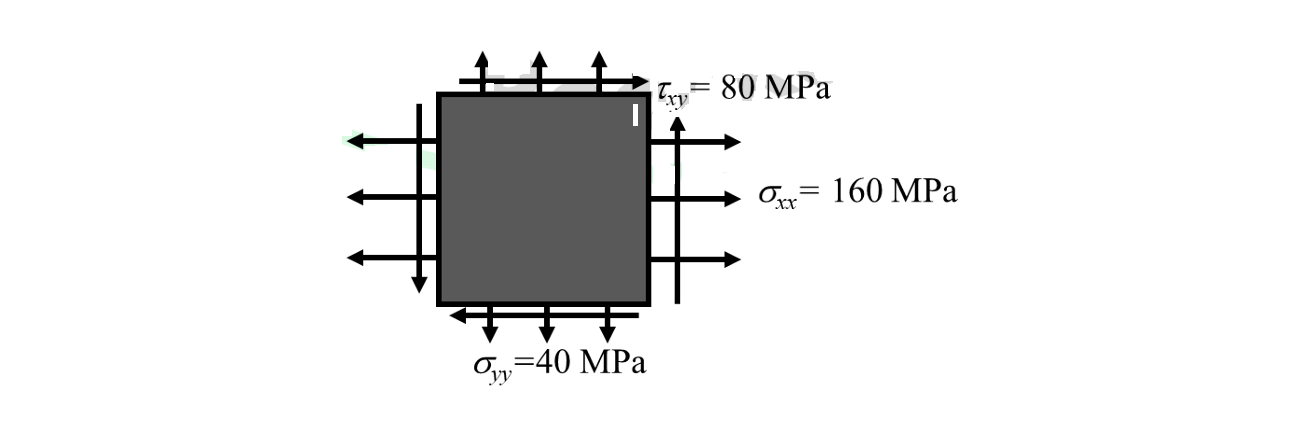
A thin flat plate is subjected to the following stresses: σxx=160 MPa; σyy=40 MPa; τxy=80 MPa. Factor of safety is defined as the ratio of the yield stress to the applied stress. The yield stress of the material under uniaxial tensile load is 250 MPa. The factor of safety for the plate assuming that material failure is governed by the von Mises criterion is _____ (rounded off to two decimal places).\text{A thin flat plate is subjected to the following stresses: } \sigma_{xx}=160 \text{ MPa; } \sigma_{yy}=40 \text{ MPa; } \tau_{xy}=80 \text{ MPa. } \\\\ \text{Factor of safety is defined as the ratio of the yield stress to the applied stress. } \\\\ \text{The yield stress of the material under uniaxial tensile load is 250 MPa. } \\\\ \text{The factor of safety for the plate assuming that material failure is governed by the } \\\\ \text{von Mises criterion is \_\_\_\_\_ (rounded off to two decimal places).}

Question 59
Q60Aerospace Engineering · 2 marks · NAT

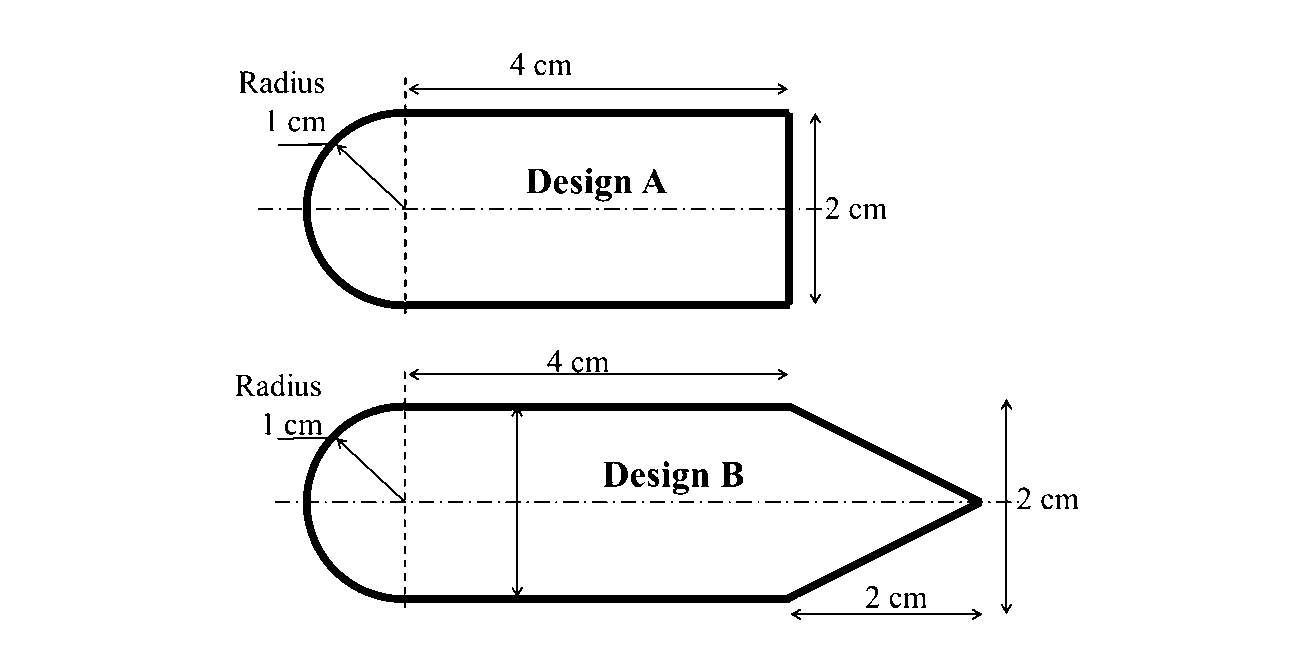
Two designs A and B, shown in the figure, are proposed for a thin-walled closed section that is expected to carry only torque. Both A and B have a semi-circular nose, and are made of the same material with a wall thickness of 1 mm. With strength as the only criterion for failure, the ratio of maximum torque that B can support to the maximum torque that A can support is _____ (rounded off to two decimal places).\text{Two designs A and B, shown in the figure, are proposed for a thin-walled closed } \\\\ \text{section that is expected to carry only torque. Both A and B have a semi-circular } \\\\ \text{nose, and are made of the same material with a wall thickness of 1 mm. With } \\\\ \text{strength as the only criterion for failure, the ratio of maximum torque that B can } \\\\ \text{support to the maximum torque that A can support is \_\_\_\_\_ (rounded off to two } \\\\ \text{decimal places).}

Question 60
Q61Aerospace Engineering · 2 marks · NAT

An ideal turbofan with a bypass ratio of 5 has core mass flow rate, m˙a,c=100 kg/s. The core and the fan exhausts are separate and optimally expanded. The core exhaust speed is 600 m/s and the fan exhaust speed is 120 m/s. If the fuel mass flow rate is negligible in comparison to m˙a,c, the static specific thrust (T/m˙a,c)developed by the engine is _____ Ns/kg (rounded off to the nearest integer).\text{An ideal turbofan with a bypass ratio of 5 has core mass flow rate, } \dot{m}_{a,c}=100 \text{ kg/s. } \\\\ \text{The core and the fan exhausts are separate and optimally expanded. The core } \\\\ \text{exhaust speed is 600 m/s and the fan exhaust speed is 120 m/s. If the fuel mass } \\\\ \text{flow rate is negligible in comparison to } \dot{m}_{a,c}, \text{ the static specific thrust } (T/\dot{m}_{a,c}) \\\\ \text{developed by the engine is \_\_\_\_\_ Ns/kg (rounded off to the nearest integer).}

Q62Aerospace Engineering · 2 marks · NAT

Air at temperature 300 K is compressed isentropically from a pressure of 1 bar to 10 bar in a compressor. Eighty percent of the compressed air is supplied to a combustor. In the combustor, 0.88 MJ of heat is added per kg of air. The specific heat at constant pressure is Cp=1005 J/kg/K and the specific heat ratio is γ=1.4.The temperature of the air leaving the combustor is _____ K (rounded off to one decimal place).\text{Air at temperature 300 K is compressed isentropically from a pressure of 1 bar to } \\\\ 10 \text{ bar in a compressor. Eighty percent of the compressed air is supplied to a } \\\\ \text{combustor. In the combustor, 0.88 MJ of heat is added per kg of air. The specific } \\\\ \text{heat at constant pressure is } C_{p}=1005 \text{ J/kg/K and the specific heat ratio is } \gamma=1.4. \\\\ \text{The temperature of the air leaving the combustor is \_\_\_\_\_ K (rounded off to one decimal place).}

Q63Aerospace Engineering · 2 marks · NAT

A monopropellant liquid rocket engine has 800 injectors of diameter 4 mm each, and with a discharge coefficient of 0.65. The liquid propellant of density 1000 kg/m3 flows through the injectors. There is a pressure difference of 10 bar across the injectors. The specific impulse of the rocket is 1500 m/s. The thrust generated by the rocket is _____ kN (rounded off to one decimal place).\text{A monopropellant liquid rocket engine has 800 injectors of diameter 4 mm each, } \\\\ \text{and with a discharge coefficient of 0.65. The liquid propellant of density } \\\\ 1000 \text{ kg/m}^3 \text{ flows through the injectors. There is a pressure difference of 10 bar } \\\\ \text{across the injectors. The specific impulse of the rocket is 1500 m/s. The thrust } \\\\ \text{generated by the rocket is \_\_\_\_\_ kN (rounded off to one decimal place).}

Q64Aerospace Engineering · 2 marks · NAT

An ideal ramjet with an optimally expanded exhaust is travelling at Mach 3. The ambient temperature and pressure are 260 K and 60 kPa, respectively. The inlet air mass flow rate is 50 kg/s. Exit temperature of the exhaust gases is 700 K. Fuel mass flow rate is negligible compared to air mass flow rate. Gas constant is R=287 J/kg/K, and specific heat ratio is γ=1.4. The thrust generated by the engine is _____ KN (rounded off to one decimal place).\text{An ideal ramjet with an optimally expanded exhaust is travelling at Mach 3. The } \\\\ \text{ambient temperature and pressure are 260 K and 60 kPa, respectively. The inlet air } \\\\ \text{mass flow rate is 50 kg/s. Exit temperature of the exhaust gases is 700 K. Fuel } \\\\ \text{mass flow rate is negligible compared to air mass flow rate. Gas constant is } \\\\ R=287 \text{ J/kg/K, and specific heat ratio is } \gamma=1.4. \text{ The thrust generated by the } \\\\ \text{engine is \_\_\_\_\_ KN (rounded off to one decimal place).}

Q65Aerospace Engineering · 2 marks · NAT

A single-stage axial compressor, with a 50% degree of reaction, runs at a mean blade speed of 250 m/s. The overall pressure ratio developed is 1.3. Inlet pressure and temperature are 1 bar and 300 K, respectively. Axial velocity is 200 m/s. Specific heat at constant pressure, Cp=1005 J/kg/K and specific heat ratio, γ=1.4.The rotor blade angle at the outlet is _____ degrees (rounded off to two decimal places).\text{A single-stage axial compressor, with a 50\% degree of reaction, runs at a mean } \\\\ \text{blade speed of 250 m/s. The overall pressure ratio developed is 1.3. Inlet pressure } \\\\ \text{and temperature are 1 bar and 300 K, respectively. Axial velocity is 200 m/s. } \\\\ \text{Specific heat at constant pressure, } C_{p}=1005 \text{ J/kg/K and specific heat ratio, } \gamma=1.4. \\\\ \text{The rotor blade angle at the outlet is \_\_\_\_\_ degrees (rounded off to two decimal places).}